Service 04
General Contracting
You have drawings. You have a budget. You need a general contractor who won't lowball the bid, drown you in change orders, and deliver a building that fails its first inspection. The gap between a number on paper and a building that works is filled by sequencing knowledge, trade coordination, and a superintendent who's built this type of project before — not just managed one from a trailer.
When to Hire a General Contractor vs. Construction Manager
Hire a GC when you have a complete set of construction documents, want a single fixed price (lump sum or GMP), and prefer to delegate all trade coordination to one responsible party. The GC assumes schedule and cost risk in exchange for their markup.
A GC relationship works best when: the design is 90%+ complete before bidding, the scope is well-defined with minimal unknowns, and you want one contract and one point of accountability for the finished product.
Consider construction management instead if: you need cost transparency for a board or lender, the scope may evolve during construction, or you want direct contracts with subcontractors. Consider design-build if you don't yet have drawings and want one team from concept through CO.
Commercial, institutional, and government owners with a complete set of drawings who want a single fixed-price contract and one point of accountability.
Not the right fit for standard residential work or projects where you only need labor pricing against a finished set of drawings and want no input on means and methods. Select custom homes and estates are served through Luxury Home Building.
Speak with Danto
Get a straight answer on feasibility, budget, and schedule for your project.
Schedule ConsultationWhat 40 Years in This Market Teaches You.
HVHZ compliance: every opening, every fastener, every roof attachment in the High-Velocity Hurricane Zone must meet Miami-Dade product approvals (NOAs). We verify compliance during submittals — not during inspection, when a rejection costs you two weeks.
Tilt-wall and precast concrete: South Florida's industrial market runs on tilt-wall construction. We've erected hundreds of panels across Broward and Miami-Dade, managing the crane logistics, bracing sequences, and pour schedules that make tilt-wall efficient.
Occupied renovation sequencing: when your tenants can't vacate, we phase the work — dust barriers, negative air pressure, after-hours demolition, and weekend MEP rough-ins. Life-safety systems stay active throughout.
Dewatering and flood-zone construction: eastern Broward and Miami-Dade parcels often require dewatering during foundation work and FEMA-compliant finished-floor elevations. We coordinate with SFWMD and local floodplain administrators early.
How We Run It
Bid Review & Scope Confirmation
Deliverable: Detailed scope letter + exclusions list
Before signing, we walk you through our bid line by line — what's included, what's excluded, what assumptions we've made. No ambiguity. No 'that wasn't in my scope' six months later.
Subcontractor Procurement
Deliverable: Qualified sub list + bid comparison
We bid every trade to 3–5 qualified subcontractors we've vetted on previous projects. We share the bid spread with you on request. Every sub carries the insurance and bonding your project requires.
Mobilization & Site Work
Deliverable: Site logistics plan + SWPPP + MOT (if applicable)
Before the first shovel hits dirt: erosion control, stormwater management, maintenance of traffic (if on a public ROW), and a site logistics plan showing crane placement, material staging, and access routes.
Vertical Construction
Deliverable: Daily logs + weekly schedule updates + inspection coordination
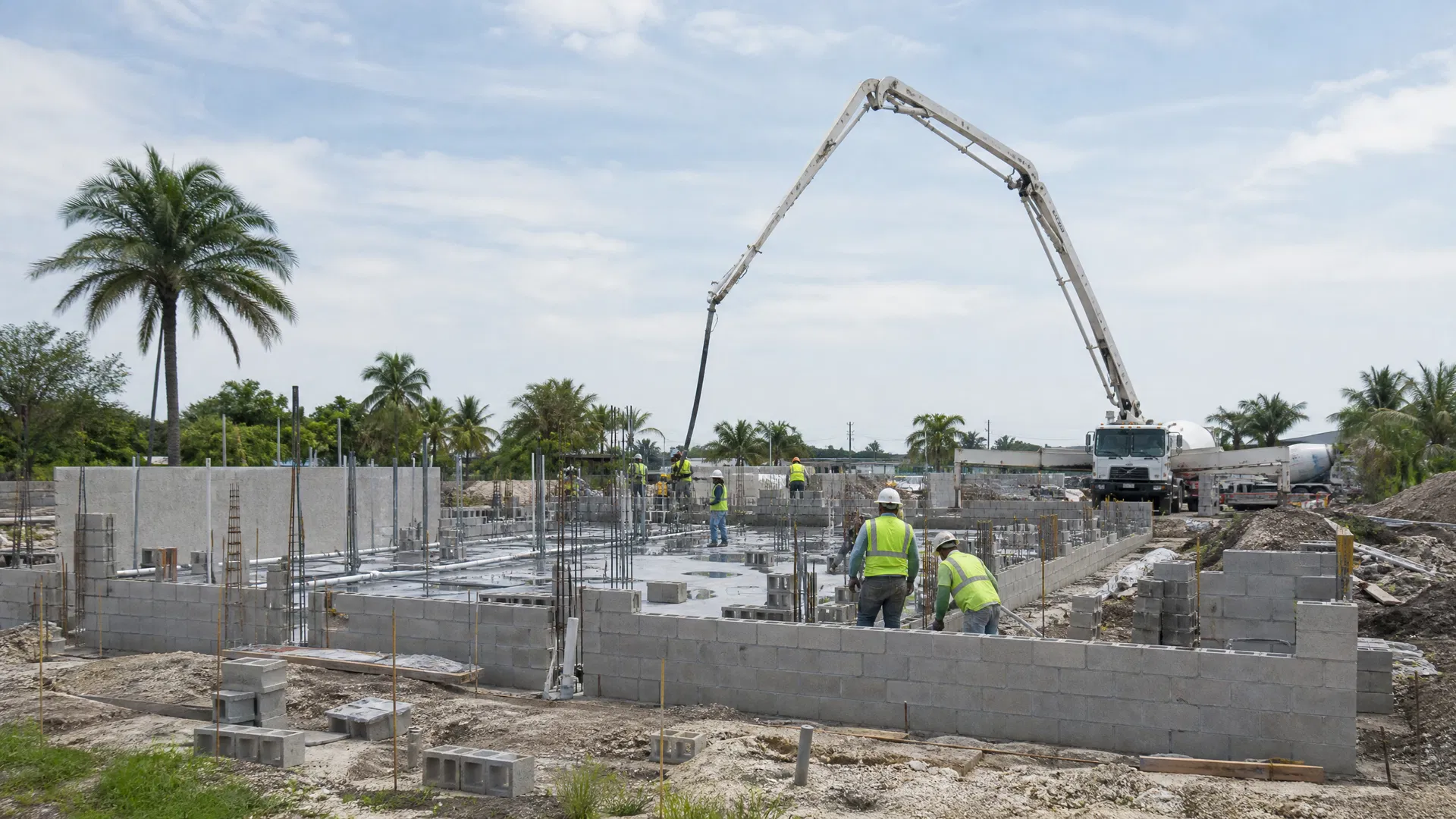
Self-performed concrete, framing, or site work where our crews deliver better quality and schedule control. Specialty trades coordinated through daily huddles and a master schedule updated weekly.
Punch & Closeout
Deliverable: Punch list + CO + closeout binder with warranties and as-builts
Systematic punch list walked with you and your architect. Final inspections coordinated. Certificate of occupancy obtained. Complete closeout package delivered: warranties, as-builts, lien releases, and O&M manuals.
Questions You May Have
What types of projects do you build?
Industrial, medical, restaurant and hospitality, retail, multi-family, aviation, marine, government, institutional, and faith-based projects. We also take on a select number of custom luxury homes and estates through our Luxury Home Building service.
Do you self-perform any trades or subcontract everything?
We self-perform selective demolition, concrete, and general carpentry where our crews deliver better quality control and schedule certainty. All specialty trades (MEP, roofing, fire protection, elevators) are subcontracted to vetted specialists we've worked with across multiple projects.
How do you handle a project that's already behind schedule when we hire you?
We start with a recovery schedule: identify the critical path, determine which activities can be crashed or overlapped, and price the acceleration cost honestly. Sometimes it's overtime. Sometimes it's additional crews. Sometimes it's resequencing trades. We'll tell you what's realistic and what it costs — not what you want to hear.
What's your bonding capacity?
We maintain bonding capacity for projects up to $25M single and $50M aggregate through a surety with an A.M. Best A-rated carrier. For projects requiring performance and payment bonds, the cost is typically 1–3% of contract value, passed through at cost.
Ready to bring your vision to life? Let's talk.
Whether you are evaluating a site, preparing a renovation, or planning a ground-up commercial development, an early conversation can help you clarify scope, timelines, budget considerations, and next steps.